Gaming has never been more popular. Yet the way people actually play has shifted in a direction that many in the industry did not see coming. While consoles remain impressive machines and PC rigs continue to push graphical limits, a growing number of players are quietly choosing something far simpler: opening a browser tab.
This is not about a niche crowd. It is a mass behavioural shift driven by one of the most underrated forces in modern life: the lack of time.
The Reality of Modern Life and Why It Changes Everything
Think about your average weekday. You wake up, commute, work, handle errands, cook, and by the time the evening arrives you have perhaps 30 to 45 minutes of genuine downtime before sleep. In that window, the idea of booting up a console, installing an update, loading into a lobby, and grinding ranked matches simply does not fit. It feels like more work.
This is the lived experience for the majority of adults who still want to play games. They are not looking for a second job with extra steps. They want something quick, satisfying, and immediate. That shift in expectation has made online games played directly in a browser one of the fastest-growing segments in all of digital entertainment.
Console Gaming: Genuinely Impressive, But Demanding
To be fair to consoles, the case for them remains strong in the right context. Here are the genuine advantages they offer.
Pros of Console Gaming
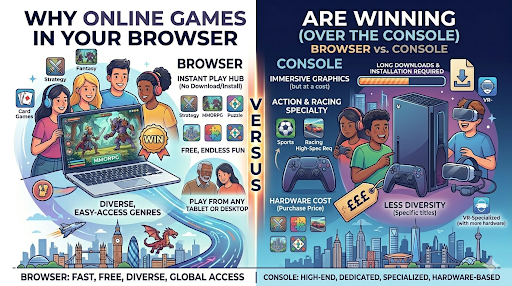
Console hardware is purpose-built for performance. Games like Fortnite, Call of Duty, and the latest AAA releases are engineered to look and run at their best on dedicated hardware. The graphics, physics, and audio design of a modern console title are difficult to match anywhere else. For players who have the time and appetite for deep, story-driven or competitive experiences, a console delivers in ways a browser simply cannot.
The social ecosystem around consoles is also mature. Friends lists, party chat, clan systems, and live events create a sense of community that goes well beyond the game itself. For those invested in that world, as explored in Call of Duty Accounts Explained: Skins, Stats, and Success, the progression and personalisation systems alone can become a significant part of the appeal.
Cons of Console Gaming
The barriers, however, are real and growing. A current-generation console costs several hundred pounds before you have bought a single game. Games themselves regularly launch at £60 to £70, and many require online subscriptions on top of that. Storage fills up fast, forcing regular management of what stays installed. Updates can run to gigabytes and arrive whether you want them or not, meaning that loading up a game on a Wednesday evening might first require a 20-minute wait.
Then there is the physical commitment. A console ties you to a room, a television, and a specific setup. You cannot play on your lunch break, on a commute, or in the kitchen while something cooks.
Browser Gaming: Surprisingly Capable, Genuinely Convenient
Browser gaming has a reputation problem. Many people still picture the Flash games of the early 2000s, basic and forgettable. What exists today is categorically different.
Pros of Browser Gaming
Thanks to HTML5 and modern browser technology, the quality of browser-based games has increased dramatically. Puzzle games, action titles, racing games, strategy experiences, and multiplayer .io games all run smoothly in a standard browser window, on any device, without a single download.
The access model is what makes browser gaming so compelling for busy people. You do not install anything, create an account, or spend any money to get started. You simply open a page and play. For someone with 15 minutes between tasks, that frictionless entry is everything. Platforms hosting tens of thousands of titles make variety a non-issue, and cross-device compatibility means you can play on whatever screen happens to be in front of you.
The cost factor deserves particular emphasis. Virtually every browser game is free to play. For casual players who are not looking to invest serious money in gaming, this removes a genuine barrier entirely.
Cons of Browser Gaming
Browser gaming is not without its limitations. The depth of experience available in the browser rarely matches what a dedicated console title can offer. If you are looking for a 60-hour open world game with cinematic storytelling, the browser is not the right place. The same is true for high-performance competitive gaming; the kind of precision and responsiveness that serious multiplayer demands, as discussed in Low Latency, High Fun: RDP Tips for Smooth Gaming, requires dedicated hardware setups that a browser environment cannot replicate.
Browser gaming also lacks the deep progression systems and persistent worlds that make console titles so absorbing over long periods. If sustained investment in a single game is what you enjoy, the browser catalogue is thinner ground.
Why the Browser Is Winning for the Majority of Players
Here is the thing that console advocates often miss: most people playing games today are not hardcore gamers. They are adults with jobs, families, and packed schedules who enjoy gaming as one of several leisure activities. They are not trying to reach Diamond rank or speedrun a new release. They want a bit of fun that fits around everything else.
For that audience, the browser wins on almost every metric. It is fast, free, accessible on any device, and requires zero commitment. You can play for five minutes or an hour, and neither choice carries any consequence.
The broader gaming industry has recognised this reality, with Exploring the Top 10 UK Game Development Companies showing how even established studios are now building for casual and mobile-first audiences rather than focusing exclusively on premium console releases.
Even players who own consoles are turning to browser gaming during the week, saving their dedicated hardware for weekends when they have more time to settle in. The two formats are increasingly complementary rather than competitive, but when time is the constraint, the browser wins by default.
The Casual Player Has Been Waiting for This
There is a whole generation of people who grew up playing games but drifted away when life got busier. They still enjoy the idea of gaming. They just cannot justify the expense, the learning curve, or the time required to re-engage with a modern console ecosystem. Browser gaming is the format that brings them back.
That is not a consolation prize. For titles designed around short, satisfying sessions, puzzle mechanics, quick multiplayer rounds, and accessible controls, the browser is the ideal environment. Even dedicated console players, deep into Fortnite Pro Tips: Advanced Strategies to Win More Battle Royale Matches one evening, might spend their lunch break the next day enjoying a quick puzzle or racing game in the browser. These are not the same kind of experience, and they do not need to be.
Final Thought
Console gaming is not going anywhere. For those who have the time, budget, and dedication to invest in it, it remains an extraordinary form of entertainment. But the direction of travel in gaming culture is clear. Shorter sessions, lower barriers, no cost, any device. The browser checks every one of those boxes, and for the majority of people who play games around a busy life rather than building their life around games, that is exactly what matters.