Lifting the Veil on the Lost Continent of Mu: A Critical Examination and Family Legacy


Featured Author: Jack E. Churchward | Work: Lifting the Veil on the Lost Continent of Mu, Motherland of Men
Part I: The Silence in the Family Tree
When children grow up, they often inherit stories of greatness, heroism, or eccentricity from their ancestors. For Jack E. Churchward, discovering his family lineage came with a heavy dose of skepticism and an outright wall of silence. In school, when another student casually asked him if he was related to the famous writer James Churchward, Jack had no immediate answer. He turned to the person who should have known best: his father.
The response he received was definitive and entirely devoid of romanticism. His father bluntly told him that James had made it all up and that there was not a lick of truth to anything he wrote. James’s books were notably absent from his father’s collection, and young Jack took his word for it without a second thought.
The disconnect within the family ran deep, rooted in a history of estrangement. After returning from Sri Lanka, which was known as Ceylon back then, James Churchward found himself alienated from his relatives. According to the family lore passed down through generations, Jack’s great-grandmother harbored a deep animosity toward James, ensuring that all contact with him was severed entirely after the 1890s. To the immediate household, James was not an enlightened pioneer of ancient history, but rather a controversial and distant figure best left buried in the past.
Decades passed, and Jack moved quietly into adulthood, carrying a famous surname while holding fast to his family’s dismissive narrative. But the dawn of the internet age and the rise of social media platforms changed the landscape entirely. In the late 2000s, people from all over the world began finding Jack online, flooding his inbox and text messages with burning questions about his great-grandfather’s work.
At first, Jack handled these inquiries exactly the way his father had taught him. He parroted the same dismissive replies, assuming he knew all there was to know. But as the volume of questions grew, a quiet realization settled in. He was merely repeating someone else’s opinion without actually knowing the facts for himself.
That realization served as the catalyst for a profound personal journey. Jack decided to take matters into his own hands and start independent research into his great-grandfather’s life and theories so he could provide accurate, well-founded answers. He built a website, started a blog, and launched a YouTube channel to document his discoveries.
The turning point of his investigation arrived through a stroke of unexpected luck. Someone who had purchased James’s original scrapbooks at an estate sale contacted Jack, offering them up for acquisition. Jack secured those precious scrapbooks as a cornerstone for his research. Aside from a rare biography written by James’s close friend Percy Tate Griffith, which Jack later self-published, these scrapbooks remained the only authentic, original documents he ever received to anchor his historical investigation.
Popular culture remembers James Churchward almost exclusively as the prophet of Mu, the man who dreamed of a lost Pacific civilization. Yet, when examining his life through the meticulous research of his great-grandfather, a much broader and more fascinating picture emerges. Writing about lost continents was merely a late chapter in an extraordinarily diverse and productive life.
James did not spend his youth spinning esoteric yarns. In his earlier years, he was a practical man of industry and enterprise. He worked as a tea planter in Sri Lanka, trained as a civil engineer, and applied his technical mind to practical innovations. He even held official patents for railroad accessories and specialized armor plating designed for World War I battleships.
Jack is currently writing a comprehensive biography of James to bring this full, unvarnished picture of his life forward into the light. Yet, even as he honors the complexity of his ancestor’s professional background, Jack remains entirely transparent about the foundational myths of Mu. To clear up any confusion regarding the origins of those famous writings, Jack points directly to the historical record, noting that James’s own biographer stated James admitted he made all the Mu material up.
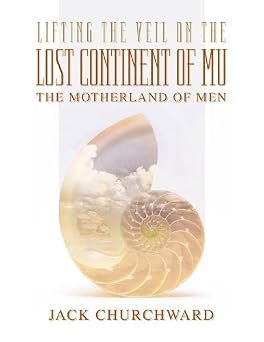
When an author takes on the immense task of republishing or analyzing a controversial relative’s work, readers often expect a protective hagiography. They anticipate a defensive manuscript designed to shield the ancestor from criticism and validate every eccentric claim. Jack Churchward approached Lifting the Veil on the Lost Continent of Mu, Motherland of Men from an entirely different vantage point.
Jack was under no illusions or requirements to blindly honor his ancestor’s voice, especially because he knew from the outset that the material was a work of fiction. Instead of functioning as an uncritical cheerleader for the existence of a sunken continent, Jack positioned his book as a rigorous, critical examination of the contents of James’s original writings.
To achieve this, Jack structured his book to provide a dual layer of information. He included the full text of James’s original books, but paired them directly with extensive footnotes and appendices containing the actual results of his own independent research. As Jack points out, if a reader picks up the book, reads the core text, and never ventures into the footnotes or appendices, they completely miss all the results of his investigative work. His mission was never to prove that Mu was real, but rather to uncover and present the unvarnished truth about James’s life and creative output.
When stripping away the elaborate mythology, the alleged translations of Naacal tablets, and the dramatic tales of ancient cataclysms, what remains at the heart of the Churchward legacy? For Jack, peering through decades of historical research and family separation, the answer is remarkably simple and deeply human.
When asked what he hopes readers take away from the intellectual puzzle of Mu, Jack points to a single, unifying sentiment. He agrees with one fundamental idea that James wrote: the profound truth that we are all one big human family. Everything else written across those pages, in Jack’s view, remains just a compelling story.
Today, Jack does not view his years of meticulous research as carrying his great-grandfather’s torch. He sees himself strictly as a historian setting the record straight, separating the romantic mythmaker from the brilliant, complicated engineer who came before him.
And if he could step back in time for just one hour to sit down face-to-face with James after all these years of carrying his name and investigating his past? Jack’s answer has nothing to do with lost continents, ancient tablets, or historical debates. He notes that he would rather just go fishing with him and talk about the simple realities of his life.