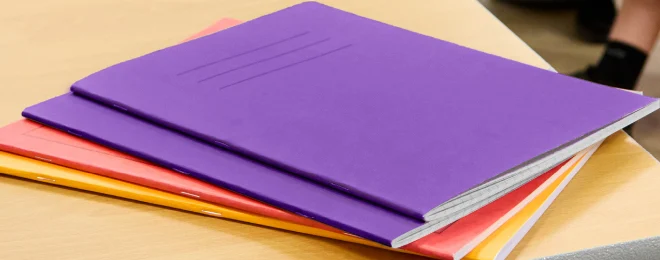
Some lessons need more room than a standard exercise book can offer. When pupils are writing longer answers, setting out research notes, drawing diagrams or working across several stages of a task, a larger page can make the work easier to manage.
That is where A4 exercise books are still a useful choice for schools. They are not needed for every subject, but they do have a clear place in classrooms where space, presentation and layout matter.
Better for Work That Needs Space
A4 books are often chosen for subjects where pupils need to show more than short written answers. In science, they can be useful for diagrams, tables, observations and practical write ups. In geography, they give pupils room for maps, labelled sketches, case study notes and data work.
They can also work well in English and humanities when pupils are planning longer responses, making notes, comparing sources or developing written answers over a full page.
The main benefit is simple. Pupils have more room to think on the page. Work can be laid out more clearly, which also makes it easier for teachers to read, mark and give feedback.
Useful for Diagrams, Tables and Planning
Not all classroom work fits neatly into narrow lines. Some tasks need space for arrows, labels, working out, corrections and teacher comments. A4 exercise books give pupils more flexibility, especially when the work includes both writing and visual elements.
They are also useful for planning. Pupils can draft ideas, organise information, create mind maps or build a structured answer without running out of space too quickly. This can be particularly helpful for older pupils who are preparing for assessments and need to practise organising longer pieces of work.
Choosing the Right Ruling
A4 exercise books are available in different rulings, so schools can choose the format that suits the subject. Lined pages work well for written subjects, while squared pages are useful for maths, science, graphs and data tasks. Plain pages can support art, design, diagrams and project work.
Margins can also be helpful. They give teachers space to mark work clearly and give pupils a defined area for corrections, dates or notes. For schools that want consistency across a year group or department, choosing the same ruling and cover colour can make book management much easier.
Colour Coding by Subject
Cover colour might seem like a small detail, but it makes a difference in a busy classroom. Many schools use different colours for each subject so pupils can find the right book quickly. It also helps teachers when books are collected, stored or moved between classrooms.
For example, a department may use green A4 books for science practical work, blue for humanities projects or yellow for intervention work. The exact system does not matter as much as keeping it consistent. Once pupils know what each colour means, classroom routines become quicker.
When A4 Books Are the Better Choice
A4 books are not always the most practical option for every lesson. They take up more space in trays and bags, and some younger pupils may find them harder to handle. For quick written tasks, smaller books may be more suitable.
However, for project work, extended writing, diagrams, assessment preparation and subjects that need clearer layout, A4 exercise books are often worth using. They give pupils more space to produce work that is organised and easier to follow.