Your car battery rarely fails without warning. The problem is that most drivers don’t know what those warnings look like, or they brush them off as “just one of those things.” By the time the car refuses to start on a cold Guildford morning, the battery has usually been struggling for weeks. Keeping on top of your vehicle’s health through a regular MOT test is one of the most reliable ways to catch electrical and battery issues before they leave you stranded.
The good news is that batteries give you plenty of signals before they give up entirely. Knowing what to look for means you can act before you’re stuck on the driveway or waiting for assistance in a car park. Pairing that awareness with a routine full car service ensures your battery, alternator, and charging system are all checked together, not just when something goes wrong. This guide walks you through every warning sign, from the obvious to the ones most people miss.
Warning Signs You Should Never Ignore
These are the symptoms that show up first, and the ones that send most drivers searching for answers.
A Slow or Sluggish Engine Crank
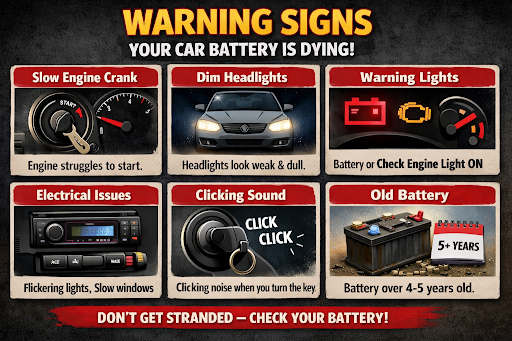
When you turn the key and the engine sounds like it’s dragging itself awake, that’s not normal. A healthy battery fires the starter motor instantly. A battery losing its charge struggles to deliver the burst of power needed, so the engine cranks slowly, sounds laboured, and takes longer than usual to catch.
This is often one of the very first signs, and it’s easy to dismiss, especially on cold mornings when slow starts feel expected. Don’t ignore it. If it happens more than once, the battery deserves attention.
Clicking When You Turn the Key
A single loud click, or a rapid series of clicks with no engine response, means the battery doesn’t have enough power to engage the starter motor properly. The battery can still power your lights and radio at low draw, but that high-amperage burst needed to crank the engine is beyond it.
If you hear clicking and nothing else, a jump start might get you going temporarily, but the battery needs testing as soon as possible.
Dim or Flickering Headlights
Your battery powers every electrical system in the car, including the headlights. When battery voltage drops, the lights are usually the first place you notice it. They might appear slightly duller than usual, flicker when you rev the engine, or seem to dim when you’re sitting at idle.
A quick check: park facing a wall in low light, turn the headlights on with the engine off, and watch for any flickering within the first 60 seconds. A healthy battery holds steady. A struggling one won’t.
The Battery Warning Light
The battery-shaped warning light on your dashboard is your car’s way of telling you the charging system isn’t performing as it should. If the charge warning light comes on while driving, it may mean the battery isn’t charging, and this should be investigated promptly to avoid loss of power to lights and other electrical systems.
It doesn’t always mean the battery itself is the problem, it could be the alternator, a loose connection, or a damaged cable, but it should never be ignored. If this light appears on your dashboard, get the car checked without delay.
Quick-Reference Symptom Guide
| Warning Sign | What It Likely Means | How Urgent |
| Slow, sluggish engine crank | Battery losing charge capacity | Check within the week |
| Rapid clicking, engine won’t start | Battery cannot power the starter | Immediate, book now |
| Dim or flickering headlights | Insufficient voltage output | Check soon |
| Battery warning light on | Charging system fault | Urgent, do not ignore |
| Electrical accessories misfiring | Voltage dropping under load | Book a diagnostic |
| Swollen or misshapen battery case | Overheating, internal damage | Replace immediately |
| Rotten egg or sulphurous smell | Acid leak from battery | Stop driving, get it checked now |
The Signs Most Drivers Miss
This is where most articles stop, and where most drivers get caught out. The obvious signs above are hard to ignore once you know them. But batteries also show subtler symptoms that are easy to write off as minor quirks.
Electrical accessories behaving oddly. When your battery voltage drops, your car’s electrical systems feel it first. The heated seats take longer to warm up, the electric windows respond slowly, the radio resets itself, or the dashboard lights flicker briefly on startup. These aren’t random glitches, they’re a low-voltage warning. If several electrical features start misbehaving around the same time, the battery is a strong suspect.
Needing jump starts more than once in a short period. A single jump start after leaving your lights on overnight is nothing to worry about. Needing one twice in a fortnight, with no obvious reason, is a different story. A battery that can’t hold charge between normal drives is a battery approaching the end of its life.
Short journeys that never let the battery recover. This is one of the most common and least understood causes of early battery failure, particularly for drivers in and around Guildford doing short urban runs. Starting the engine draws a significant surge of power from the battery, power that is only fully replenished on longer drives. If you’re regularly doing five-minute journeys and nothing longer, the battery is slowly depleting with every trip. Over time, this incomplete charging cycle wears it down faster than age alone would.
Parasitic drain from modern accessories. Dashcams wired into a permanent live feed, aftermarket stereos, GPS trackers, and even keyless entry systems draw a continuous low-level current from the battery when the car is parked. Individually, the draw is small. Combined, or with a battery that’s already ageing, it can be enough to leave you with a flat battery overnight. If your car keeps dying despite being driven regularly, parasitic drain is worth investigating.
Your battery’s age. Most car batteries last between three and five years under normal UK driving conditions, though AGM batteries fitted to vehicles with stop-start systems can last somewhat longer. If you don’t know how old yours is, you can find out your battery’s age, it takes less than a minute and gives you a clear picture of where you stand. A battery past four years old showing any of the above symptoms should be tested without delay.
What to Check Under the Bonnet
If you suspect your battery is struggling, a quick visual inspection can tell you a lot before you even speak to a mechanic. You don’t need tools, just open the bonnet and look.
- Terminal corrosion. Look at where the cables attach to the battery. If you see a white, blue, or greenish powder caked around the terminals, that’s corrosion caused by battery acid vapour reacting with the metal. Corrosion restricts the flow of electricity between the battery and the car’s systems, and it accelerates battery deterioration. Light corrosion can sometimes be cleaned, but persistent build-up usually signals the battery is on its way out.
- A swollen or misshapen battery case. Car batteries are rectangular, if the sides look bulged, bloated, or warped, the battery is overheating internally. This can happen when a battery is overcharged or exposed to extreme heat. A swollen battery is not safe to continue using and should be replaced immediately.
- A rotten egg or sulphurous smell. Batteries should have no smell whatsoever. If you detect something close to rotten eggs or a sewage-like odour near the battery, that’s hydrogen sulphide, a sign the battery is leaking acid internally. This is one of the most serious warning signs on this list. Do not continue driving. Get the car to a garage as soon as safely possible.
Battery, Alternator, or Starter? How to Tell the Difference
This is the question that confuses drivers most, and it matters, because replacing the battery when the alternator is the real fault means you’ll be back to square one within weeks. Here’s a straightforward way to think about it.
The battery stores and delivers electrical power. The alternator recharges the battery while the engine runs. The starter motor uses that battery power to crank the engine and get it going. All three can produce similar-looking symptoms, but they fail in different ways.
The most practical test: jump-start the car and drive for at least 30 minutes. If the car runs normally throughout and starts again afterwards without issue, the battery was most likely the problem, it could not hold charge, but the alternator is working correctly. If the car starts but then loses power or dies within minutes of driving, the alternator is the likely culprit, it is not recharging the battery while the engine runs.
| Symptom | Battery | Alternator | Starter |
| Slow crank, eventually starts | ✓ | Possible | — |
| Rapid clicking, will not start | ✓ | — | ✓ |
| Car starts but dies shortly after | — | ✓ | — |
| Lights dim while engine is running | — | ✓ | — |
| Single loud click, engine does not crank | — | — | ✓ |
| Battery warning light on while driving | Possible | ✓ | — |
| Battery keeps dying despite regular driving | Possible | ✓ | — |
If you are unsure after this test, a garage can confirm the diagnosis with a charging system check in minutes. Asking them to test the alternator at the same time as the battery is always worth doing, it rules out the most common mistake at replacement time.
What to Do If You Think Your Battery Is Failing
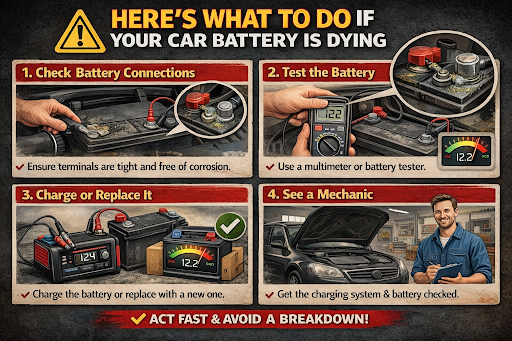
Acting early saves you from an unexpected breakdown and, in many cases, from needing a full replacement sooner than necessary. Here is what to do the moment you suspect a problem.
- Don’t wait for the car not to start. The warning signs covered in this article are your window to act. Once the battery can no longer start the engine, you lose all control over when and where the problem happens.
- Do a visual check under the bonnet. Look for corrosion, swelling, and any unusual smell. Even if you see nothing obvious, the visual check rules out the most urgent issues.
- Book a battery health check. A proper battery test measures the battery’s ability to hold and deliver charge under load, not just its current voltage. This is the only reliable way to know whether a battery is genuinely healthy or just holding on.
- Ask for the alternator and charging system to be checked at the same time. Replacing a battery without checking the alternator is one of the most common and costly mistakes. A faulty alternator will destroy a new battery within months.
- Consider your driving habits. If short journeys are your daily reality, a trickle charger or battery conditioner used overnight once a week can help keep the battery at a healthy charge level between uses.
How Cold Weather and Short Journeys Accelerate Battery Failure
Most drivers think of battery failure as something that just happens with age. In reality, two patterns are responsible for far more premature failures in the UK than almost anything else, cold weather and short journeys.
Cold Weather Exposes Weakness That Already Exists
A car battery works through a chemical reaction between lead plates and an electrolyte solution. When temperatures drop, that reaction slows down significantly. At freezing point, a typical lead-acid battery can lose between 30 and 40 percent of its available power output. This is why a battery that starts your car without issue throughout summer can leave you stranded on a cold morning in Guildford, the cold doesn’t kill the battery outright, but it exposes weakness that was already developing. A battery with 60 percent of its original capacity remaining might cope through a mild autumn without a single problem. That same battery in February will not.
Short Journeys Drain More Than They Restore
Every time you start the engine, the battery delivers a significant surge of power to the starter motor. That charge is replenished by the alternator as you drive, but the alternator needs time and engine speed to do its job. On a journey of five to ten minutes, it simply isn’t long enough to replace what was used at startup. Do this repeatedly and the battery’s charge level gradually drops with each trip, never quite recovering between uses. Over time, this degrades the battery’s internal structure and shortens its lifespan considerably. It’s a pattern that goes unnoticed because the car still starts, right up until it doesn’t.
What You Can Do
| Action | Why It Helps |
| Use a battery conditioner or trickle charger | Keeps the battery at a healthy charge level between short trips, preventing gradual depletion |
| Take a longer drive once a week | Gives the alternator enough time to fully replenish what startup journeys drain away |
| Get a battery check before winter | Identifies weakness before cold weather removes any remaining margin: regular maintenance being important |
| Know your battery’s age | A battery over three years old heading into winter should be tested, not assumed healthy |
Conclusion
Your battery is trying to tell you something long before it gives up entirely. A sluggish start on a damp morning in Guildford, a dashboard light you’ve been ignoring, a radio that keeps resetting, these aren’t coincidences. They’re a battery asking for attention.
The frustrating thing about battery failure is the timing. It never happens when you’re already at the garage for something else. It happens on a Monday morning when you’re already running late, or on a cold January evening in a dark car park. That’s not bad luck, that’s what happens when the early warnings go unanswered. Cold temperatures reduce a battery’s available power output significantly, which is why a battery that copes in summer can fail completely in winter. The warning signs were there in the warmer months. Winter simply removes any remaining margin.
It’s also worth remembering that the battery doesn’t work in isolation. The alternator, the starter motor, the wiring, and the condition of the terminals all play a role in how reliably your car starts and runs. A battery problem that goes undiagnosed long enough can put strain on the alternator, and an alternator problem that goes undetected will destroy a brand new battery in a matter of months. Getting the full charging system checked, not just the battery in isolation, is always the smarter move.
If you’ve read through this article and recognised one or more of these symptoms in your own car, that recognition is worth acting on today. A battery health check is one of the quickest and most straightforward checks a garage can carry out. It takes minutes, gives you a clear picture of how much life is left, and puts you back in control. Drivers in and around Guildford don’t need to wait until the car won’t start to get answers. The signs are already there, you just need to know where to look.
Frequently Asked Questions
How long does a car battery last in the UK? Most car batteries last between three and five years, depending on driving habits, climate, and how well the charging system is maintained. Batteries in vehicles with stop-start systems often use AGM technology and can last slightly longer, though they are more sensitive to incorrect replacement. If your battery is approaching the three-year mark, it is worth having it tested proactively.
Can a car battery die suddenly with no warning? It can feel that way, but it is rarely truly sudden. Modern cars are very good at compensating for a weakening battery, which makes the early symptoms easy to miss. The sluggish crank, the occasional dim light, the electrical accessory that misbehaves, these are the warning signs. By the time the car won’t start at all, the battery has usually been declining for some time.
What does a dying battery sound like? The clearest sound is a slow, laboured crank when you turn the key, the engine sounds like it is struggling to turn over rather than firing cleanly. You may also hear rapid clicking, which indicates the battery cannot deliver enough power to the starter motor to crank the engine at all.
Why does my car battery keep going flat even though I drive every day? Short journeys are the most common reason. If your daily drive is under 15 minutes, the alternator may not have enough time to fully replenish the charge used to start the engine. Over time, this leads to a gradually depleting battery. Parasitic drain from accessories like dashcams and keyless entry systems can also cause this, as can a failing alternator that is no longer charging the battery effectively while you drive.
Is it the battery or the alternator? Jump-start the car and drive for at least 30 minutes. If the car runs normally throughout and starts again on its own, the battery was most likely the problem. If the car dies again within minutes of being jump-started, the alternator is probably at fault, it is not recharging the battery while the engine runs. A garage can confirm this with a quick charging system test.