If your MOT has expired, or you’re not sure whether it’s still valid, you’re not alone. It’s one of the most searched motoring questions in the UK, and the answer matters, because getting it wrong can cost you more than just a fine.
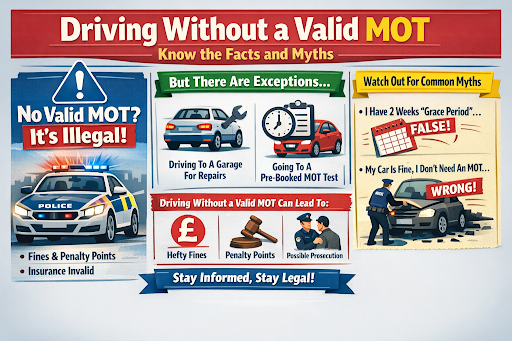
The short answer is yes, in most cases, driving without a valid MOT is illegal. But there are exceptions worth knowing, and a few common myths that catch drivers off guard.
The Legal Reality
In the UK, any vehicle over three years old must have a valid MOT certificate to be driven on public roads. This is a legal requirement under the Road Traffic Act 1988, not a recommendation.
According to GOV.UK, driving without a valid MOT can result in:
- A fine of up to £1,000
- Your vehicle being deemed unroadworthy
- Serious complications with your car insurance
There are no penalty points attached to this offence, but the financial and legal consequences are significant enough to take seriously.
The Grace Period Myth
This is the big one. Many drivers in Farnborough and across Hampshire believe there is a one-month grace period after their MOT expires. There is not.
This myth likely stems from the fact that you can renew your MOT up to one month early without losing any days on your certificate. But once your current MOT expires, you are no longer legally permitted to drive the vehicle on public roads, full stop.
If you are caught driving with an expired MOT, the date on your certificate is the only thing that matters to the police and to your insurer.
When You Can Drive Without a Valid MOT
There are two situations where driving without a current MOT certificate is permitted.
Driving to a Pre-Booked Test Appointment
If your MOT has expired, you are legally allowed to drive your vehicle directly to a pre-booked MOT test appointment. The key word here is pre-booked. If you have not made an appointment in advance, this exemption does not apply.
The journey must be direct, and the vehicle must not be used for any other purpose on that trip. Drivers in areas like Ash Vale and North Camp should plan the most direct route to their nearest test centre and avoid any unnecessary detours.
Vehicles Exempt from MOT Testing
Certain vehicles do not require an MOT at all. These include:
- Vehicles manufactured before 1 January 1960
- Electric vehicles and those with historic vehicle status (subject to conditions)
- Some agricultural vehicles and those not used on public roads
If your vehicle falls into one of these categories, you can confirm your exemption status via the GOV.UK MOT exemptions page.
What Happens to Your Insurance?
This is where drivers in Fleet, Tongham, and beyond often get an unwelcome surprise. Most insurance policies do not automatically become void the moment your MOT expires. However, if you are involved in an accident and your MOT has lapsed, your insurer may use it as grounds to reduce or reject your claim.
The reasoning is straightforward: an expired MOT suggests the vehicle has not been confirmed as roadworthy. That gives insurers a basis to argue the vehicle should not have been on the road.
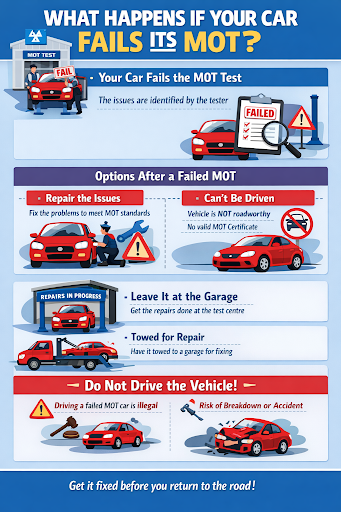
If you have recently missed your MOT and are worried about what a failed test means for your next steps, this guide on what happens if your car fails its MOT covers the process clearly.
How Police Detect an Expired MOT
Many drivers assume that without a visible certificate in the window, no one will know. That assumption is outdated. Here is exactly how detection works:
| What | How It Works |
| ANPR Cameras | Fitted to police vehicles and roadside posts, these cameras scan number plates automatically as vehicles pass |
| DVLA Database Check | Each plate is cross-referenced against the DVLA database in real time, flagging any vehicle without a valid MOT instantly |
| No Stop Required | An officer does not need to pull you over or inspect any paperwork. The system alerts them before they even approach your vehicle |
| Fixed Roadside Units | Static ANPR cameras are mounted at key locations, meaning detection is not limited to moving patrol vehicles |
| Aldershot Routes | This technology is actively deployed on key roads in and around Aldershot, making the chances of going undetected far lower than most drivers realise |
The system is fast, automatic, and increasingly widespread. Assuming you will not be caught is a risk that simply is not worth taking.
MOT vs Service: Knowing the Difference
A common source of confusion is whether a recent car service replaces the need for an MOT. It does not. The two are entirely separate.
An MOT checks whether your vehicle meets the minimum legal safety standards required to be on the road. A service focuses on the mechanical health and longevity of the vehicle, covering things like oil, filters, and wear components.
If you are unsure which your vehicle needs right now, this breakdown of the difference between an MOT and a service explains it in plain terms.
What to Do If Your MOT Has Lapsed
Do not panic, but do act quickly. Here is what to do:
- Stop driving the vehicle on public roads immediately, unless you are heading directly to a pre-booked test appointment
- Check your MOT status using the official GOV.UK MOT checker by entering your registration plate
- Book your MOT as soon as possible at a local test centre serving your area
- Arrange alternative transport in the meantime if your appointment is not immediate
- Notify your insurer if there is any chance you have driven the vehicle while the MOT was expired
Drivers across Ash, Tongham, and the surrounding Hampshire area can often get same-week appointments if they act promptly. The longer you leave it, the greater the risk.
Keeping on Top of Your MOT
The easiest way to avoid this situation is to treat your MOT like a bill with a fixed due date. Set a reminder on your phone 30 days before it expires. You can renew up to a month early without losing any time on your certificate, so there is no reason to leave it to the last minute.
Pairing your MOT with your regular car servicing means both are handled together, reducing the chance of either slipping through the net.
What the MOT Actually Checks
Drivers sometimes underestimate what an MOT covers, which is part of why some treat an expired certificate casually. The test is not a simple once-over. It is a structured inspection of over 40 individual components, carried out against national standards set by the Driver and Vehicle Standards Agency.
The inspection covers three broad categories: safety, roadworthiness, and environmental impact. Within those, inspectors assess:
- Brakes: Tested for balance, efficiency, and stopping power across all four wheels
- Tyres: Checked for tread depth (minimum 1.6mm), sidewall condition, and correct fitting
- Lights and indicators: Every bulb, from headlights to brake lights, must function correctly
- Steering and suspension: Inspected for wear, play, and structural integrity
- Seatbelts: All belts must lock, retract, and fasten properly
- Windscreen and wipers: Checked for cracks in the driver’s line of sight and wiper effectiveness
- Exhaust emissions: Measured against legal limits depending on the vehicle’s fuel type
- Horn, mirrors, and visibility: All must meet the minimum legal standard
A vehicle that has not been inspected could have developing faults in brakes or tyres that are invisible to the untrained eye but dangerous at motorway speeds. The MOT exists precisely to catch those issues before they cause harm.
It is also worth noting that MOT results are recorded on the DVLA database. You can view your vehicle’s full MOT history, including any advisories from previous tests, through the official government vehicle checker. Advisories are not failures, but they flag components approaching the point of concern and should be monitored or addressed before the next test.
Can You Drive a Company or Borrowed Vehicle Without an MOT?
This question comes up more than you might expect, particularly among drivers who use a work vehicle, borrow a family member’s car, or drive for someone else regularly. The answer is the same regardless of who owns the vehicle: if the car does not have a valid MOT, it cannot legally be driven on public roads.
The offence is tied to the vehicle, not the owner. Here is what that means in practice:
| Situation | Who Is Responsible |
| Employer asks you to drive a company vehicle with a lapsed MOT | You as the driver are at risk of prosecution, not just the business |
| Borrowing a friend or family member’s car without checking MOT status | Any fine or insurance complication falls on you as the driver |
| Involved in an accident in a vehicle with an expired MOT | Your legal and financial position is precarious regardless of who was at fault |
| Driving a vehicle you do not own but use regularly | You are still expected by law to verify the vehicle is roadworthy before driving |
Ignorance is not a legal defence in any of these cases. The law expects the driver to take responsibility for the roadworthiness of the vehicle they choose to operate.
The simplest habit to develop is to check the MOT status of any unfamiliar vehicle before driving it. All you need is the registration plate and the official government MOT checker. Drivers in and around Aldershot who regularly share or borrow vehicles should make this a standard step, just as they would check fuel or adjust the mirrors.
How Long Does an MOT Take?
Once you have booked your appointment, most standard MOT tests take between 45 minutes and one hour to complete for a typical passenger car. That said, the total time at the garage can vary depending on how busy the test centre is, whether any issues are identified, and how quickly any repairs can be carried out.
Understanding what happens after the inspection helps you plan properly:
- Pass with no issues: You receive your certificate on the day, usually within the hour, and the result is uploaded to the DVLA database automatically
- Pass with advisories: The vehicle passes, but the tester flags components that are not yet at failure level but should be monitored. You leave with a valid certificate and a list of items to keep an eye on
- Fail with minor issues: Some test centres can carry out minor repairs on the same visit, allowing the vehicle to be retested and passed the same day
- Fail with significant issues: The vehicle cannot be certified until the necessary repairs are completed. Depending on the nature of the failure, this could mean leaving the car at the garage and arranging alternative transport
Booking an early morning slot on a day when you have flexibility is always a sensible approach, particularly if your vehicle has existing advisories from its last test. Knowing the possible outcomes in advance means you can plan your day around the appointment rather than being caught off guard by an unexpected result.
What If Your MOT Runs Out While Abroad?
This is a less common but genuinely tricky situation that catches some drivers off guard, particularly those who take extended trips to Europe or leave a vehicle with family overseas. If your MOT expires while you are travelling outside the UK, you are still legally required to hold a valid certificate to drive the vehicle on UK roads when you return.
Here is what you need to know if this situation arises:
- Before you travel: Check your MOT expiry date against your return date. If there is any overlap, renew early. You can book up to one month before expiry without losing any days on your current certificate
- While abroad: Some European countries accept a valid UK MOT as proof of roadworthiness for short visits. Others have their own requirements. Check the entry rules for each country you plan to drive through before departure
- If your MOT expires during the trip: Do not drive the vehicle back into the UK on public roads until the MOT is resolved. In practice, this may mean arranging for the vehicle to be transported, or booking a test at the earliest opportunity upon return
- Insurance implications abroad: An expired MOT may affect the validity of your European breakdown cover or foreign travel insurance policy. Review your policy documents or contact your insurer before the trip if the timing is close
The straightforward way to avoid this entirely is to treat your MOT renewal as part of your pre-travel checklist, alongside checking your tyres, oil, and breakdown cover. Drivers heading away from Aldershot for an extended period should factor this in with the same seriousness as passport checks and travel insurance.
Conclusion
Driving without a valid MOT is not a grey area. It is illegal in almost every circumstance, and the consequences, from fines to insurance complications to instant ANPR detection, are real and increasingly difficult to avoid.
The rules are straightforward. If your MOT has expired, stop driving. If you need to get to a test centre, make sure the appointment is pre-booked before you set off. If you are borrowing or driving someone else’s vehicle, check its MOT status before you turn the key. None of these steps take long, but skipping them can be costly.
It is also worth remembering that the risks do not stop at a fine. An insurer who discovers your MOT had lapsed at the time of an accident has grounds to complicate or reject your claim. ANPR cameras operate around the clock, on patrol vehicles and fixed roadside units alike, meaning the assumption that you will not be caught is no longer a reasonable one to make.
An MOT is not just a legal box to tick. It is confirmation that your vehicle meets the minimum safety standards required to be on the road, for you, for your passengers, and for everyone else sharing that road with you. The inspection covers everything from brake efficiency to tyre tread depth to exhaust emissions. A vehicle with an expired certificate has not had those checks carried out, and that matters every time you pull out of your driveway.
Keeping on top of your MOT is one of the simplest and most responsible things you can do as a driver. Set a reminder a month before your expiry date, book early, and use the government MOT checker to stay informed about your vehicle’s status at any time. If your vehicle has advisories from a previous test, address them before your next inspection rather than leaving them to become failures.
The bottom line is this: the MOT system exists to keep roads safe, and the rules around it exist for good reason. Staying compliant is not just about avoiding a fine. It is about taking your responsibilities as a driver seriously, every time you get behind the wheel.
Frequently Asked Questions
Is there a grace period after my MOT expires? No. There is no grace period. Once your MOT certificate expires, driving the vehicle on public roads is illegal.
Can I drive to a garage without a valid MOT? Yes, but only if you are driving directly to a pre-booked MOT appointment. The journey must be direct and purposeful.
Will my insurance be void if my MOT has lapsed? Not automatically, but an expired MOT can give your insurer grounds to reduce or reject a claim if you are involved in an accident.
How do police know my MOT has expired? ANPR cameras cross-reference your number plate against the DVLA database instantly, without needing to stop your vehicle.
What is the fine for driving without an MOT? You can be fined up to £1,000 for driving without a valid MOT certificate.
Can I drive a SORN’d vehicle without an MOT? A SORN’d vehicle must not be driven on public roads at all, regardless of MOT status. It can only be kept on private land.