35% Cost Overruns How to Avoid Budget Traps and Delivery Delays in Custom Gear Manufacturing

Introduction
Outsourcing precision gears in a globalized supply chain has become the norm, but it comes with risks such as quotes that vary significantly from the actual cost, delayed timelines, and parts that do not function in the manufacturing phase.The root cause is typically an information gap across the gear lifecycle, with problems surfacing too late.
This article presents a framework based on Advanced Manufacturing Technology and transparent management, detailing how upfront collaboration with expert gear manufacturing companies front-loads risk control for mastery over cost and schedule. Building this resilient partnership requires mastering five key dimensions.
Design Stage Collaboration: Locking in 80% of Manufacturing Cost at the Source
The principle that design determines 80% of cost is critical for custom gears. Success requires shifting from a sequential “throw-over-the-wall” approach to integrated, upfront engineering collaboration.
Leveraging Technology for Proactive Optimization
Leading gear cutting services providers employ Advanced Manufacturing Technology—like DFM software and simulation—to digitally analyze designs. This virtual prototyping identifies manufacturability issues, cost drivers, and optimization opportunities invisible on static drawings, preventing expensive changes later.
Key Areas for Design Review and Cost Savings
A rigorous DFM review targets specific, actionable optimizations:
l Profile and Tolerance Optimization
Engineers may suggest modifying tooth profiles to use standard tooling or adjusting tolerances to meet functional needs without unnecessary precision machining costs.
l Material and Process Alternatives
They can recommend cost-effective material substitutes with equal performance and propose processes that avoid costly secondary operations for the given volume.
The Foundation of Success
This collaborative gear cutting and manufacturing approach is foundational. It transforms a transaction into a technical partnership, setting the stage for predictable outcomes. Manufacturers can explore detailed guides to understand these best practices in depth.
Beyond Unit Price: Analyzing Hidden Cost Drivers in a Quotation
Comparing unit prices alone is a flawed strategy. A transparent gear manufacturing quote should be a detailed breakdown. Key modules include: material, custom gear cutting process costs (hobbing vs. shaping), heat treatment, finishing, inspection (gear testing reports), and logistics. Each holds hidden cost risks.
Unspecified requirements are prime culprits. A missing surface finish callout or an implied tight tolerance can force a more expensive process. For low volumes, high setup costs amortized over few parts spike unit price. To mitigate this, buyers must request and scrutinize line-item breakdowns, discussing the necessity and efficiency of each chosen process with the supplier.
Evaluating True Rapid Response for Urgent Custom Transmission Gears Needs
A failed custom transmission gear can halt production. Evaluating a supplier’s real rapid response capability is therefore critical and must be based on tangible assets, not promises.
Evaluating Operational and Supply Chain Capabilities
Assessing rapid response requires examining two interconnected pillars: internal production agility and external supply chain resilience.
l Production System Flexibility
Genuine speed stems from advanced infrastructure. Key indicators include flexible manufacturing cells and integrated Smart Factory Solutions like MES, enabling real-time monitoring, dynamic scheduling, and rapid changeovers for urgent order insertion.
l Supply Network Resilience
Machines require materials. Evaluate the supplier’s strategic raw material inventory and robust sub-supplier network. Furthermore, dedicated rapid-response protocols for key clients that streamline internal approvals and prioritize workflow are essential.
The Tangible Impact of a Prepared Partner
A diversified, digitally-integrated supplier is vital for demand shocks. For example, a robotics firm needing urgent prototype custom transmission gears would benefit from a partner with flexible lines, MES, and material stock. Such a supplier can execute parallel tasks—engineering review, programming, and production insertion concurrently—potentially halving the standard lead time.
Decoding Quality Certs: Ensuring Lifecycle Control from Gear Manufacturing Companies
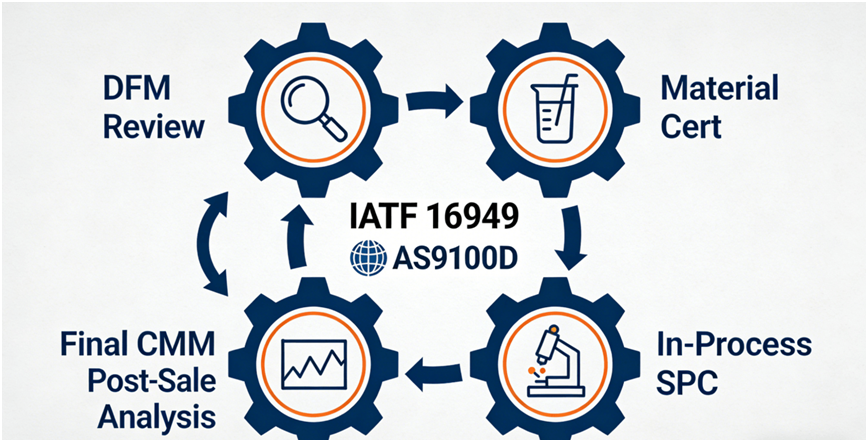
Certifications such as IATF 16949 generally indicate the existence of a management system, rather than part quality. The attention has to be on how the system is implemented in gear production. A comprehensive system should address all stages of the lifecycle: incoming material inspection, thorough First Article Inspection (FAI), in-process SPC monitoring, and final confirmation through gear testing centers. Evidence is in the paperwork. Request sample inspection reports from gear manufacturing companies to get a taste of real measurement thoroughness. A manufacturer certified to extremely strict standards like IATF 16949 (automotive) and AS9100D (aerospace) is quite a good signaling device, since these standards require preventive tools (APQP, PPAP) and very strict traceability, which are the hallmarks of a more reliable system. AS9100D, the aerospace standard with strict requirements, is described by authorities such as SAE International.
From Transaction to Partnership: The Strategic Custom Gear Manufacturer
Changing a vendor to a strategic partner results in creating even greater value through joint cost optimization, co-development and prioritization of capacity. In this respect, a strategic custom gear manufacturer not only supplies the products but also acts as an engineering extension of the client, providing process improvement ideas, capacity visibility, joint value analysis, and post-sales support such as wear analysis.
Finding the right partner called for a test run project. Criteria for assessment should highlight technical openness, raising of issues in a proactive manner, and a genuine desire to keep improvement going, apart from just time delivery. A partner who teaches is far more valuable than a partner who merely executes the print.
Conclusion
Mitigating outsourcing risk essentially means turning procurement into cooperation upfront through the use of transparent data. Manufacturers who periodically assess suppliers based on factors such as design compatibility, openness in pricing, ability to provide quick turnaround, level of quality control system, and mutual understanding potential will develop their supply chains to be more resilient.
If you are looking for a strategic partner in the development of high-reliability custom transmission gears, regulations-restricted advanced manufacturing technology integration by providers along with quality systems should be the main focus of your deep evaluation. JS Precision, aprofessional custom precision gear manufacturer, is one such example that, through complete engineering collaboration along with being certified to IATF 16949 and AS9100D standards, can provide stable support from concept to a large volume.
Author Bio
This article was authored by an industrial manufacturing guest columnist for Meta Magazine. The author has more than 10 years of practical experience in precision manufacturing and supply chain management. The author’s main goal has always been to provide value-chain optimization strategies for manufacturing decision-makers.
FAQs
Q: What is the typical lead time for custom gears?
A: Lead time can vary greatly based on the gear’s complexity, the processes involved, and the quantity ordered. For example, simple gears in small quantities might only take 2-3 weeks, whereas highly precise, large-volume productions could stretch to 6-8 weeks. It is essential to set clear stage gates with your supplier and choose a supplier who can increase production capacity at short notice if necessary.
Q: How can I ensure cost-effectiveness for low-volume custom gear orders?
A: Consider gear manufacturing methods that do not entail the use of costly dedicated tooling (e.g. CNC gear milling, shaping). Designing gears in a manner that minimizes the need for special steps in the manufacturing process can be a significant cost-saving measure, particularly when combined with a “materials + actual machine time” pricing model.
Q: What files should I provide to get the most accurate gear manufacturing quote?
A: Supply comprehensive 2D or 3D drawings clearly defining every gear detail (module, number of teeth, pressure angle), material certificates, tolerance class (e.g. AGMA or ISO standard), and heat treatment/surface finish details. Including a brief about how the gear is intended to be used will also assist in getting the best possible quotes including optimization suggestions.
Q: What does a gear’s “accuracy grade” mean in practical application?
A: The accuracy grade (e.g. ISO 5-9) specifies the overall tolerance limits for errors in pitch, profile, and helix combined. A better grade will result in quieter transmission, better efficiency, and longer life, but the cost will be substantially higher. Instead of aiming to get the highest possible grade, select the grade that best fits your actual performance requirements.
Q: What is the concrete benefit of a supplier’s IATF 16949 certification for my automotive project?
A: This certification requires the implementation of key automotive quality improvement tools such as APQP, PPAP , and SPC . It essentially indicates that the supplier has a quality management system which is preventive in nature so that they can manage risks in a systematic way, ensure the consistency of batches, and comply with the automotive industry’s very demanding requirements for traceability and reliability.