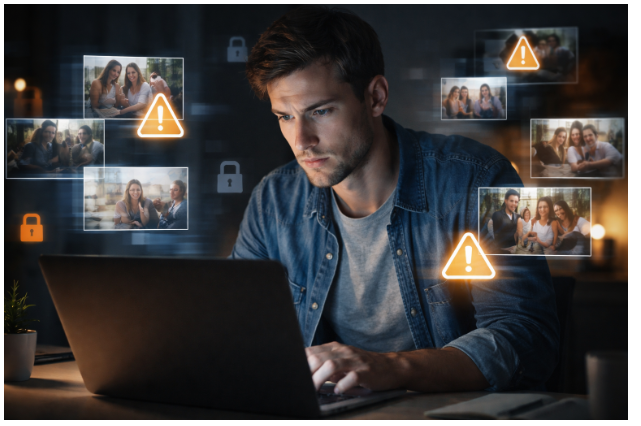
Most people think their photos are private. I used to think the same. I had uploaded two pictures to a cloud connection some time ago and hadn’t given it much thought. Later, I returned and found out that the link was still active. Anyone with that link could open my photos. It was the time when I understood how one can easily lose control without even being aware of it.
This is a form of a general problem. Many users trust default settings and forget to review them later. From working with online privacy topics, one thing is clear. Photo privacy is not about what you believe is private, but what is actually accessible. Let’s go step by step and make sure that your photo privacy is correct or not.
How to Know If Your Photos Are Already Public
Many people do not check this early. But this step helps you understand your current risk. It gives you a clear starting point before making any changes.
Here are simple signs your photos may not be private:
- Your photos appear in Google search results
- Anyone can open your photo link without logging in
- Your social media posts are set to “Public.”
- Your images appear on websites you don’t control
In case any of these are found to be true, your photos are already available online.
Quick Self-Test: Check Your Photos in 5 Minutes
This quick test gives you fast answers. It assists you in viewing whether your photos are already visible on the internet. It does not require any special equipment to begin.
Start with this simple test:
- Search your name on Google
- Click on the “Images” tab
- Look for your photos
Now try this:
- Use Google reverse image search
- Upload one of your photos
- See where it appears online
This helps you find public copies of your photos. During this, it may not expose everything, especially classified or hidden information of yours.
Full Photo Privacy Audit (Step-by-Step)
This is a deeper check than the quick test. It helps you review all areas where your photos may exist. Follow each step carefully for better results.
Follow this full check to be sure:
- Search your name on Google and check the images
- Upload your photo to reverse image search
- Open your social media profiles and review old posts
- Check all shared cloud links and folders
- Look at your photo metadata (location and details)
Go step by step. Do not skip anything. This gives you a complete view of your photo privacy.
How to Know If Your Photos Are Safe After Checking
Having finished the audit, you can now have a better picture of your privacy in relation to the photos. Some users may find everything looks fine at first. But others may notice old links, public posts, or images showing up in search results. This is done to get to know what is safe and what requires attention. It also demonstrates the extent to which you actually have control of your photos.
In case your photos are shown in the search results or are opened by a shared reference, they are not completely private. One naked picture is not enough to say that you are totally private. It is indicative of the fact that those areas must be fixed as quickly as possible. Begin by denying access, changing settings, or erasing old content. Even little modifications can result in a lot.
Check Where Your Photos Exist Online
Your photos do not stay in one place. They can spread across different platforms over time. So you need to check more than one source.
Your photos can exist in many places:
- Social media platforms
- Old blogs or websites
- Shared cloud links
- Messaging apps
Even if you deleted a photo, copies may still exist. So it is important to check all possible locations.
Why Your Photos Might Not Be Private
Many people feel safe because of the settings. But there are other ways photos can become public. These risks are often ignored.
Many people believe their photos are safe. But there are hidden risks.
- A friend can repost your photo
- Someone can take a screenshot
- Old links may still work
- Platforms may change settings over time
So even if you are careful, your photos can still spread.
Check Your Social Media Privacy Settings
Social media is one of the main sources of exposure. Many users upload photos but never review the settings later. A quick check here can reduce many risks.
- Check who can see your posts
- Review old albums
- Set visibility to “Friends” or “Only Me.”
Old photos are often left public by mistake. Also, settings can change over time, so check regularly.
- Make sure your account is private
- Check tagged photos
- Review story highlights
Tagged photos can reveal you even if you have a private account.
Other Platforms
- Twitter (X), Snapchat, TikTok
- Review past uploads
- Delete anything you don’t need
Check If Your Cloud Photos Are Public
Cloud storage is useful, but can reduce control. Many people share links without checking them later. This can leave photos open for a long time.
Cloud storage makes sharing easy. But easy sharing can also reduce control.
Many people think cloud storage means full privacy. However, it is not necessarily the case.
He can get your photos in case a person has your mutual connection.
If you use cloud storage for photos, always check:
- Active shared links
- Access permissions
- Old shared folders
Using a secure system like Paranoid helps you keep better control over your files.
Why Cloud Photo Privacy Can Be Misleading
Most individuals believe that photo storage in the cloud is completely confidential. Such is a popular misconception. Storing in the cloud is easy, and privacy is in your hands with regard to sharing and access. Unless you go through your settings, your photos may be more open than you assume.
A photo can be considered confidential as it is not publicly registered in search engines. However, in the case of a common connection, any human being who has the connection can still access it. These links may be forwarded without your attention. As time goes on, you can forget the access. This gives you false privacy, and you have less control over your own photos.
Google Photos and iCloud Sharing Risks
Many users rely on cloud services daily. But they often forget to review shared content. This creates long-term privacy risks.
Many people use services like:
1. Google Photos and
2. Apple iCloud.
These platforms make sharing simple. But they also create hidden risks.
- Shared links can stay active for a long time
- Anyone with the link can view your photos
- You may not know who still has access
Always review your shared albums and links. Delete anything you no longer need.
Real-Life Example: How Photos Stay Public
Real examples make the problem easier to understand. Many users face this without knowing it. It shows how small actions can lead to exposure.
Here is a common situation:
You shared a photo link with a friend. After some time, you forgot about it.
But the link still works.
Anyone who has that link can still open your photo. They can even share it again.
This is how photos stay online without you knowing.
Check Hidden Data in Your Photos (Metadata)
Most people do not know about hidden data. But it can reveal personal details easily. So it is important to check it before sharing.
Photos often contain hidden details like:
- Location (GPS)
- Device information
- Date and time
This is called metadata.
Some platforms remove this data, but not all do.
How to check:
- Right-click the photo on your computer
- Open “Properties”
- Look at details
What to do:
- Remove location data before sharing
- Use tools to clean metadata
Can AI or Face Search Find Your Photos?
Technology is improving over time. Photos can now be found in new ways. This adds another level of risk.
Some tools can find photos using faces.
This means:
- Your photo can be found even if you did not upload it
- Someone else can upload your image and make it searchable
These tools are still improving. So your photos may be easier to find than you think.
Check If Others Shared Your Photos
You are not the only one who controls your photos. Other people can share them too. This makes tracking more difficult. Even if you are careful, others may share your photos.
This can happen when:
- Friends repost your images
- Someone takes a screenshot
- Photos are uploaded to forums or websites
Use reverse image search again to find these cases.
What Makes a Photo Truly Private?
Many people confuse privacy with settings. But real privacy is about full control. You should always think about access and visibility.
A photo is private only if:
- You control who can see it
- No public link exists
- It is not searchable online
- It does not contain hidden data
Privacy is not just about settings. It is the control of what you post.
Common Mistakes People Make
Minor errors can cause great exposure. Most users repeat the same errors. Being aware of them helps you stay safe.
Many users believe their photos are safe, but:
- They forget old shared links
- They trust the default settings
- They ignore backups
- They think private accounts are enough
These small mistakes can expose your photos.
Tools to Check Photo Privacy
You do not need advanced tools for basic checks. Simple tools can give useful results. Use them regularly to stay updated.
You can use:
- Google reverse image search
- TinEye
- Manual searches on social platforms
These tools help you track where your photos appear.
How to Fix Photo Privacy Issues
Once you find problems, take action quickly. Fixing issues early reduces risk.Do not get complicated and be regular.
Follow these steps:
- Delete public or old photos
- Remove shared links
- Update privacy settings
- Clean metadata
- Review your storage platform
Also, consider safer alternatives that give you better control over your files and sharing options.
Quick Photo Privacy Checklist
This checklist helps you review everything quickly. You can use it anytime to stay updated. It is a simple way to track your privacy.
Use this checklist to confirm your privacy:
- Can you find your photo on Google?
- Do you have any active shared links?
- Are your social media accounts private?
- Did you remove location data?
- Do you know where your photos are stored?
If you answered “no” to any of these, review your settings again.
Conclusion:
Over time, I have seen that most people do not lose photo privacy on purpose. It usually happens because of small things like old shared links, public posts, or settings that were never checked again. From experience, even one forgotten link can keep photos exposed for a long time. The fact is that you can correct it as soon as you understand where your photos are and who may see them. It is worthwhile to review your photo privacy regularly and thus remain in charge of your personal content.