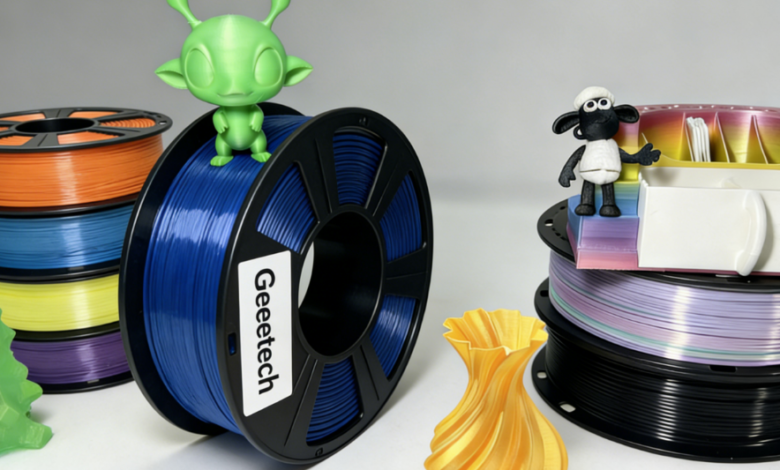
Geeetech Filament is creating a new path for 3D printing technology throughout the entire industry. The 3D printing industry has experienced impressive development since the previous decade because it transformed from an engineering technology into a manufacturing method that multiple industries now use. Today,3D printing technology serves various sectors which include healthcare, automotive, construction, education and consumer goods. The complete process of transforming this industry depends on one essential material which functions as the central element of industrial operations.
Filament quality determines the success of 3D printing projects because it has equal importance to printers and software which normally receive most attention. Reliable materials establish consistency, precision and durability which both hobbyists and professionals require. The market offers multiple filament options, but Geeetech filament has become a reliable selection because it enables users to achieve greater 3D printing capabilities.
-
Introduction
The growing importance of Geeetech filament in 3D printing. Filament is the material used in most 3D printers, especially those based on fused deposition modeling technology. The material undergoes melting and extrusion which creates three-dimensional objects through sequential layer application. The filament quality determines all outcomes of the printing process, despite the procedure’s simplicity.
Filament determines the degree to which a design converts into a physical object through its impact on surface finish, dimensional accuracy, strength and flexibility. Users experience operational problems due to poor-quality filament, which causes clogging, inconsistent extrusion, warping, and weak structures. The problems waste both time and material resources while creating frustration for users who want to achieve exact outcomes.
Geeetech filament works well with a variety of 3D printers which enables more people to use it for their printing needs. The right settings enable entry-level printers and advanced machines to produce identical results.
-
Understanding the Role of PLA Filament
Among the different types of filament available, PLA (Polylactic Acid) remains one of the most popular choices. The material serves as the best option for beginners because it permits simple usage and provides multiple chances to succeed. The material provides advantages that exceed the needs of entry-level users.
PLA exists as a renewable resource because it derives from corn starch and sugarcane which makes it sustainable in comparison to petroleum-based plastics. People increasingly use the material for their personal and professional needs because of its sustainable nature.
-
Benefits of PLA Filament
The three main benefits of PLA Filament make it a reliable material for use in different applications.
-Ease of Printing
The printing process of PLA Filament gives the user an opportunity to print with this material because it offers an easy printing experience. PLA adheres well to the printing surface without a closed environment, making it a perfect option for a beginner in 3D printing.
-Less Warping
The PLA material retains its original form even after cooling because it can withstand temperature changes without showing any signs of warping.
-Smooth Surface Finish
PLA Filament offers the user an opportunity to produce 3D printing objects which have a smooth surface finish, making it a suitable option for the production of decorative items.
-Biodegradable Composition
PLA Filament acts as a reliable option for use as a production material because it exists in nature and can replace plastic products in the market.
-Less Odor Emission
PLA Filament offers a reliable option for use in 3D printing because it emits minimal odors during the printing process, making it a suitable option for use in different environments, including homes and offices.
-
Applications of Filament in Industry
The most important advantage of using a 3D printing technique is its ability to produce a prototype quickly. This enables designers and engineers to make changes and enhance the product.
-Custom Manufacturing
This printing technique enables businesses to manufacture products as per the requirements of customers. The possibilities of custom products are endless.
-Tooling and Fixtures
Manufacturers are using this printing technique to produce tools and fixtures to enhance their products. These tools and fixtures are being produced quickly and at a lower cost.
-Medical Applications
3D printing technology serves three functions in medical science by enabling prosthetic production, surgical model creation and the development of biocompatible medical components. The accuracy and reliability of the filament become critical factors because they directly affect the results of medical operations.
-
Tips for Achieving Better Printing Results
Reliable filament serves as a vital component for successful printing operations yet proper procedures must be implemented to achieve optimal results.
-Calibrate Your Printer:
The bed level and extrusion need to be calibrated because this is an important step for accurate results.
-Choose Reliable Materials:
The use of reliable materials from reliable companies ensures that there is little or no chance of making mistakes during the printing process.
-
The Future of Filament Technology
The future of PLA 3D filament is extremely bright. Scientists and experts are working day and night to invent new kinds of filaments for better results.
-Sustainable Materials
As environmental issues are becoming more and more common, there is a huge emphasis on creating new kinds of filaments, called sustainable materials, which can help in protecting the environment.
-High-Strength Composites
The invention of new kinds of filaments is based on adding strength using carbon and glass fibers, along with other metals. These kinds of filaments are used for industrial purposes.
-Smart Filaments
In order to improve this technology, new kinds of materials, called smart materials, have been invented. Smart filaments have been used for making wearable electronics and electronic circuits.
-Multi-Material Printing
The upcoming time will consist of different kinds of filaments for use in the printing process. This new technology helps in making objects that possess different, unique qualities.
-
Conclusion
As the 3D printing market continues to grow, so does the connection between this growth and the evolution of filament materials used in 3D printing. As the technology advances, so does the quality of 3D printing materials, which are used as the backbone for printing everything from 3D models to functional items.
Geeetech filament materials have contributed significantly to the growth of 3D printing, offering high-quality materials for use in a wide variety of 3D printing projects, whether you are a beginner or a seasoned expert in 3D printing technology.
As 3D printing technology continues to grow, so does the evolution of 3D printing materials, which are used as the backbone for printing everything from 3D models to functional items. As a result, the future of 3D printing technology has never looked brighter, and as you consider investing in 3D printing materials, you are not just making a practical decision; you are embracing a revolution in 3D printing technology.